Your treatment ended. The pain didn’t. What was missed?

Continue

What we do differently

Map. Needle. Remap.

Dr. Yang maps the tissue by hand, tracing its 3D pattern of pull to guide where and how each needle is placed. After removing each needle, he immediately remaps the tissue to guide the next.

Worried about needles or pain? You remain in control—treatment adjusts to your comfort, and you can pause anytime.

Patient experiences

What happened when
they tried something different?

Jane H.

Google Review

5 years of severe upper-back and shoulder pain, severe enough to cause sleepless nights.

Physiatrist, PT, traditional acupuncture and chiropractors couldn’t resolve it.

Pain nearly gone after several treatments; no longer wakes at night.

Tina C.

Google Review

30 years of back pain.

30+ doctors failed—MDs, PTs, chiropractors and acupuncturists—to find a solution.

Pain-free after 10 SRT sessions; no recurrence.

Nakisa N.

Google Review

Years of constant knee and lower-back pain after a car accident.

Chiropractic, PRP, myofascial therapy and two acupuncturists provided only temporary or minimal relief.

Constant pain disappeared after 3 sessions; daily hiking and biking caused no flare-up.

Individual results may vary.

Who this is for

Could This Help With What You’re Experiencing?

Four Situations Where We’ve Helped Many Patients

Your imaging didn’t explain it—
or you want a second opinion on the problem.

Whether normal, inconclusive, or showing an abnormality, your X-ray or MRI may not explain the whole problem.

Dr. Yang considers imaging when available and also examines where you hurt, what triggers it, and how the surrounding tissue behaves. Prior imaging is not required.

Treatment helped—
but not enough.

Improvement was partial, temporary, or reached a plateau.

Time passed.
The problem remained.

After an injury, accident, or overuse, you have not recovered as expected.

Pain or restricted movement still interferes with daily activities like walking, sleeping, or exercising.

Surgery was recommended—
but you want another option.

An in-person assessment can help determine whether another conservative approach is reasonable before you decide.

Concerns we evaluate

Unresolved Pain or Restricted Movement

  • Jaw pain or headaches
  • Neck, upper-back, and shoulder pain
  • Elbow, wrist, and finger pain
  • Lower-back and hip pain
  • Knee and ankle pain
  • Suspected plantar fasciitis and toe pain
  • Pain all over the body that continues to interfere with daily life

New Pain or Restricted Movement

Pain that followed a strain, twist, physical activity, fall, or direct impact—or simply came on suddenly

An X-ray is recommended after a fall or direct impact.

Other Concerns

  • Menstrual pain
  • Post-meal fullness, pressure, stomach discomfort, or acid reflux
  • Certain types of numbness, tingling, or “nerve pain”

How treatment works

Why Might This Work
When Your Previous Care Didn’t?

Scientific reasoning follows a simple loop:

  1. Observe
  2. Form a hypothesis
  3. Test it
  4. Analyze the results
  5. Re-evaluate the hypothesis

But is this reasoning
consistently applied in pain care?

An MRI finds a torn meniscus, so it is blamed for the knee pain.
What if the tear doesn’t explain how your knee actually hurts?

Research

Muscle weakness is blamed for joint pain.
What if the joint problem caused the weakness?

Research

A spinal misalignment is blamed for back pain.
But similar misalignments are often found in people without back pain—so does it really explain yours?

Research

Explanations like these are often thrown around as truth.
Yet research shows these common culprits do not always explain the pain.

The real failure is clinging to the original hypothesis
even when improvement is minimal or stalls.

Two differences define Different Acupuncture:

A rare palpation method maps what may have been missed

One possible missing factor is a suspected tissue adhesion.

It’s like a snag in fabric pulling the surrounding material out of shape.

  1. Adhesion A tether between tissues
  2. Movement It restricts glide and pulls on surrounding tissue
  3. Tension That pull concentrates tension nearby
  4. Possible effect Can cause pain or restricted movement

By hand, Dr. Yang maps the tissue’s three-dimensional pull—its direction and depth—to locate the suspected tether.

That map guides treatment.

Every Step Tests the Hypothesis

Example: Pain

Examine and Form a Hypothesis

Where does it hurt? What triggers it, and how severe is it?

What mechanical forces could be causing the pain?

Map by Hand

Trace the three-dimensional pull to locate the suspected tether.

Guide One Needle

The map guides needle placement, direction, depth, and technique to release the suspected tether.

Remove and Remap

Immediately remap to determine what happens next.

Another needle is needed Back to Step 3

What happens next?

Local treatment cycle is complete Continue to Step 5

When the local treatment cycle is complete

Reassess the Patient

Did the original pain change when retested?

If the tension map changed but the pain did not, reconsider the hypothesis.

A real treatment example

What Did This Look Like
in a Real Case?

Seven Months. Four Types of Treatment. The Pain Didn’t Change.

One Session. Four Needles. Then He Ran—Almost Pain-Free.

The problem

The pain appeared whenever he ran.

A boy came in with pain in both heels that had persisted for seven months, beginning around October 2024.

The pain appeared at 3/10 as soon as he started running and disappeared when he stopped.

Imaging
X-ray and MRI found no explanation.
Previous care
Physical therapy, chiropractic care, acupuncture, and herbal medicine.
Improvement
None. The running pain had not decreased at all.

Palpation revealed previously unidentified tethers

Could They Be Causing Uneven Force—
and His Heel Pain?

Dr. Yang palpated both sides of each heel.

His mapping identified suspected ligament adhesions along the inner sides, near the talus and calcaneus.

His working hypothesis was that these tethers might cause uneven force distribution through the heels, leading to pain when he ran.

Suspected tethers Uneven force distribution Running pain

Now the hypothesis had to be tested:
release the suspected tether, then have him run again.

The adaptive treatment

“Map. Needle. Remap.” in Practice.

Left heel

  1. Step 1 Map by Hand

    Dr. Yang located the suspected tether and traced its direction and depth.

  2. Step 2 Needle 1

    He applied a controlled tapping technique to release the tether.

  3. Step 3 Remove + Remap

    Remapping showed the tether had changed.The updated map placed the second needle site 2 mm from the first.

  4. Step 4 Needle 2

    He followed the updated map, adjusting the needle’s direction.

After the second needle was removed, remapping showed enough change to complete the left-heel treatment cycle.

Dr. Yang then repeated the Map → Needle → Remap process on the right heel, which also required two needles.

4 needles total

Time to test the hypothesis

Did Releasing the Tethers
Reduce His Pain?

After the fourth needle, Dr. Yang asked the boy to run in the hallway—the activity that had reliably triggered his pain.

“The pain is almost nonexistent now!”

The boy, after the running retest

Dr. Yang ended the session there and asked the family to monitor whether the pain returned.

Ten-day follow-up

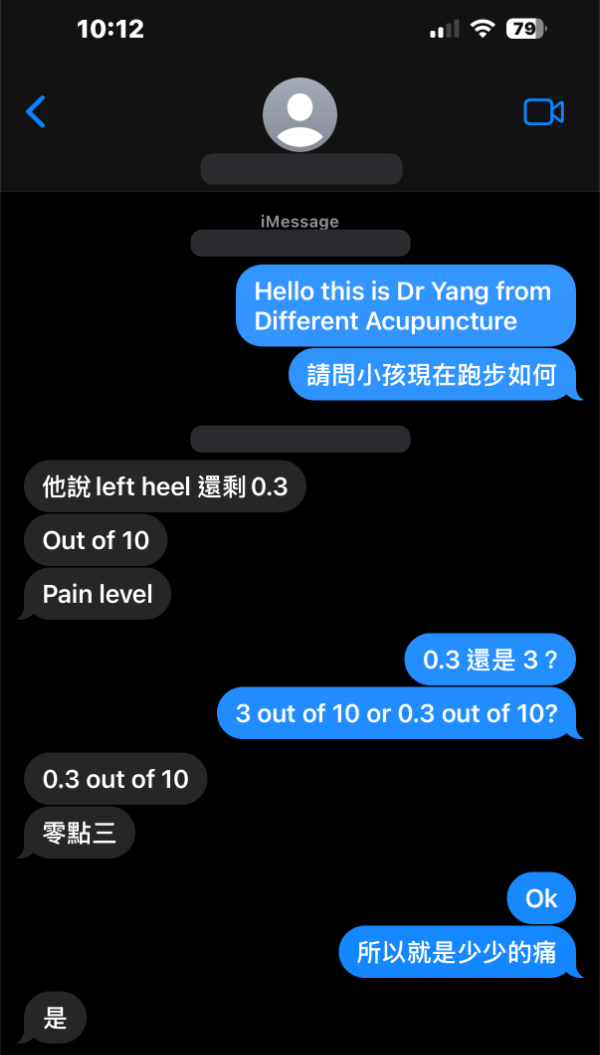
Left heel: 0.3/10.
Right heel: 0/10.

Additional treatment None No further visit was needed.

The map guided treatment.

His reduced pain when running—not the map—supported the hypothesis.

The doctor behind the approach

Who Is Dr. Yang—and Why Trust Him?

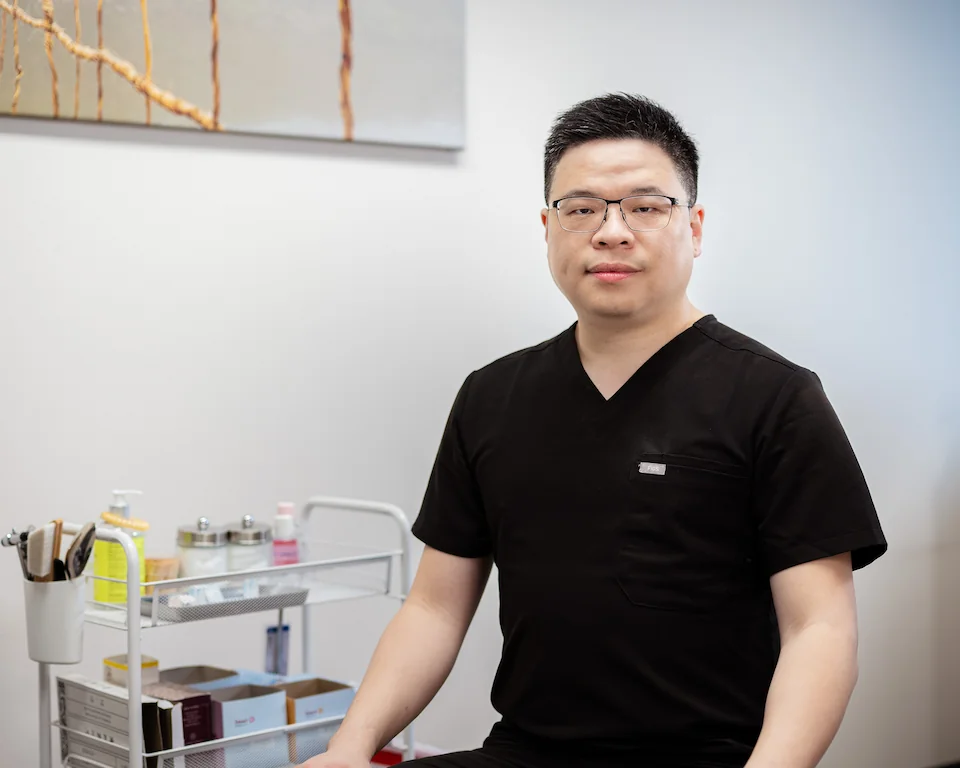
Dr. Ta Shing (Derrick) Yang in the treatment room at Different Acupuncture

Dr. Ta Shing (Derrick) Yang, L.Ac., Ph.D.

Dr. Yang built Different Acupuncture to provide the kind of care he would want to receive himself.

California-licensed acupuncturist
Since 2014 AC 16019
Education
Ph.D. in Oriental Medicine American Liberty University M.S. in Acupuncture & Oriental Medicine South Baylo University
Structural Reduction Treatment
Studying since 2017
Personal responsibility
Every assessment and treatment personally performed

For Dr. Yang, care worth trusting must do two things: practice scientific reasoning and genuinely serve the patient.

Scientific Reasoning—Practiced, Not Claimed

“Six weeks of core training, and your back still hurts? Maybe weakness isn’t the cause?
Nah—it must be. Just keep training.”

“Finger pain? Let’s do a full-spine adjustment. Is the spine actually involved? Who knows?
What if it doesn’t work? Just do it again.”

Deeply dissatisfied with care like that, Dr. Yang kept searching.

In 2017, Dr. Lin showed him that touch could “see” structural patterns, and a senior mentor helped make the difficult palpation method learnable.

Drawing on his physics background, Dr. Yang translated what he felt into a three-dimensional mechanical model of the tissues. He then spent years testing its predictions against patients’ responses.

That work became the adaptive clinical system demonstrated in the previous sections—not an inherited formula.

Patients Describe the Difference

Find what the patient couldn’t pinpoint

“As I was not able to pin point location of the pain, he patiently examined my knees to find the cause.”

Connect the findings to the pain

“My injury is complex, but Dr. Yang has shown remarkable patience in explaining how the small injuries are connected and how they contribute to my shoulder pain.”

Reassess as the problem changes

“The tricky part is that the pain/sore can move to different areas as it heals.
Dr. Yang … had me go through different stretches to properly identify the areas that needed attention.”

Care That Serves the Patient—
Not Just the Clinic.

Scientific reasoning is only half of good care. The other half is you.

Feel heard, informed, and safe.

  • Dr. Yang listens carefully to your symptom history.
  • He explains what he finds and answers your questions in detail.
  • He checks how you feel throughout treatment.
  • Treatment is adjusted or paused whenever needed—you remain in control.

Define success on your terms—not the clinic’s.

  • Success means returning to what matters to you.

Receive the care that best serves you.

  • Your problem—not our profit—determines the recommendation.
  • That includes referring you to another provider when their care fits you better.

Build independence from the clinic.

  • You receive individualized self-care guidance to help sustain your progress.

Different Acupuncture grows by producing results patients consider worth talking about—not by prolonging unnecessary treatment.

Patients Describe the Care

Feel heard, informed, and safe

“He made me feel comfortable and was reassuring.
He’s very respectful, and I feel completely safe in his hands.”

Build independence from the clinic

“He really knows what he’s doing and takes the time to understand the problem and treat it effectively.
What I appreciate most is that he also gives helpful exercises to do at home, which have made a big difference in my recovery.”

Patient results before clinic profit

“He is not a doctor who wants patients to return frequently just to make money.
He genuinely wants to solve their problems.”

Jeffrey L. Google review

English translation
from the original Chinese review.

What Does It Cost—and What If It Doesn’t Help?

Our three-session guarantee

No Results.
No Charge.

Every clinic claims to put patients first.

But almost none back that claim with their own money.

We do.

You Decide Whether It Was Worthwhile.

  1. 01

    Complete three sessions

    Complete all three sessions within one month.

  2. 02

    You decide

    Was the progress worthwhile?
    You—not the clinic—decide.

  3. 03

    If not, text us

    Request it between 7 and 60 days after Session 3.

    No questions asked

The complete terms

  • Full refund via Zelle within one business day.
  • The guarantee applies once per distinct problem.
  • Cancellation and no-show fees are excluded.
  • If Dr. Yang ends the trial early, the guarantee still applies.
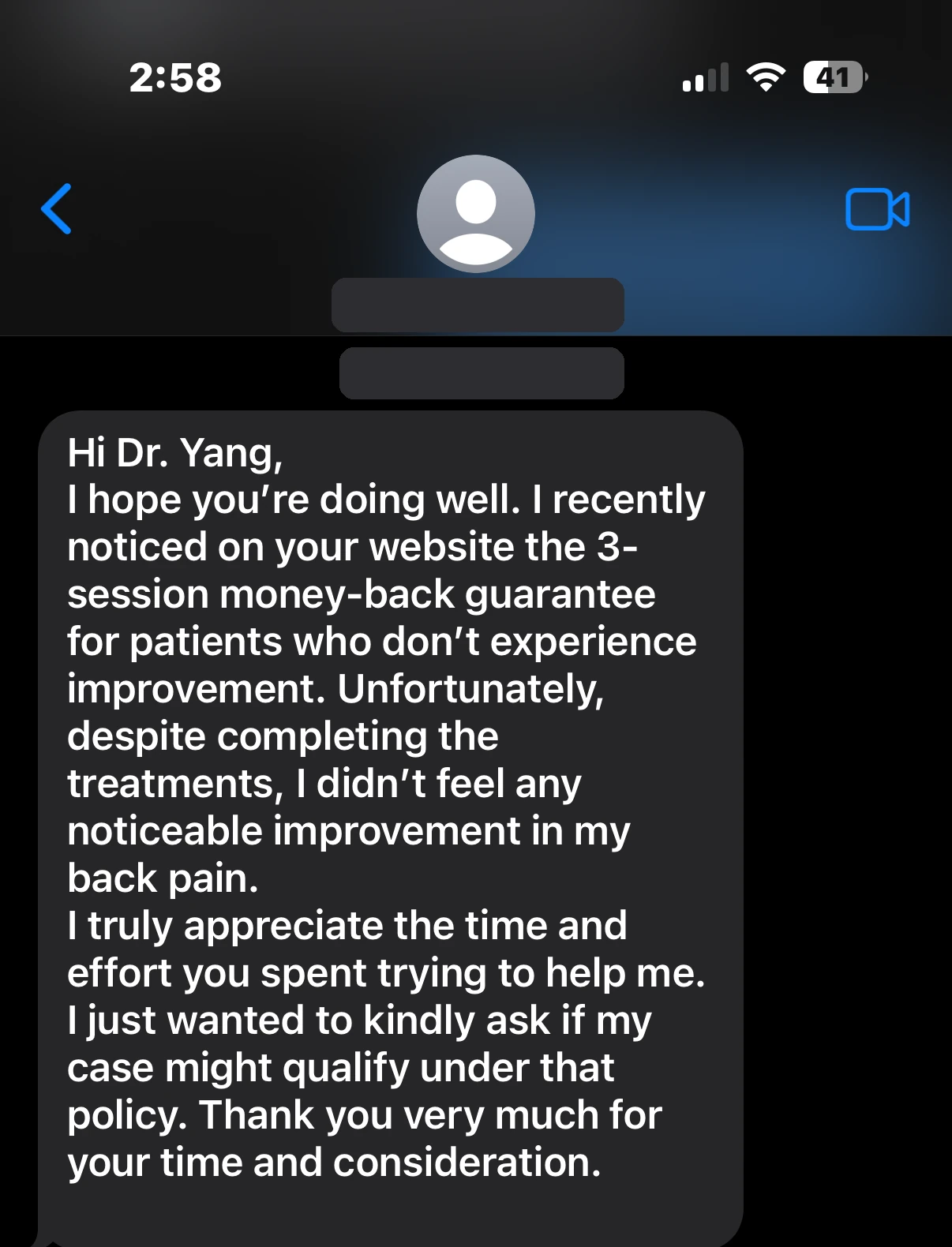
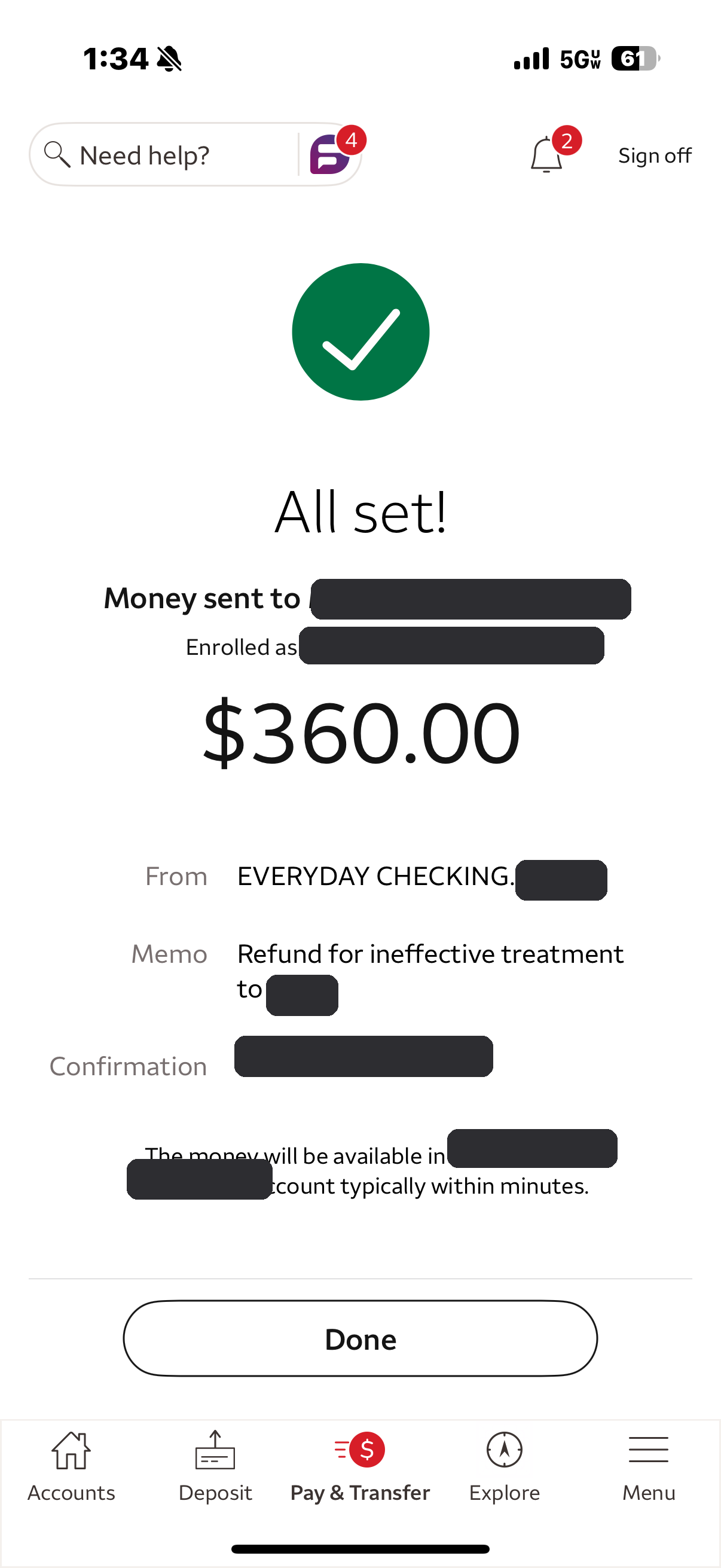
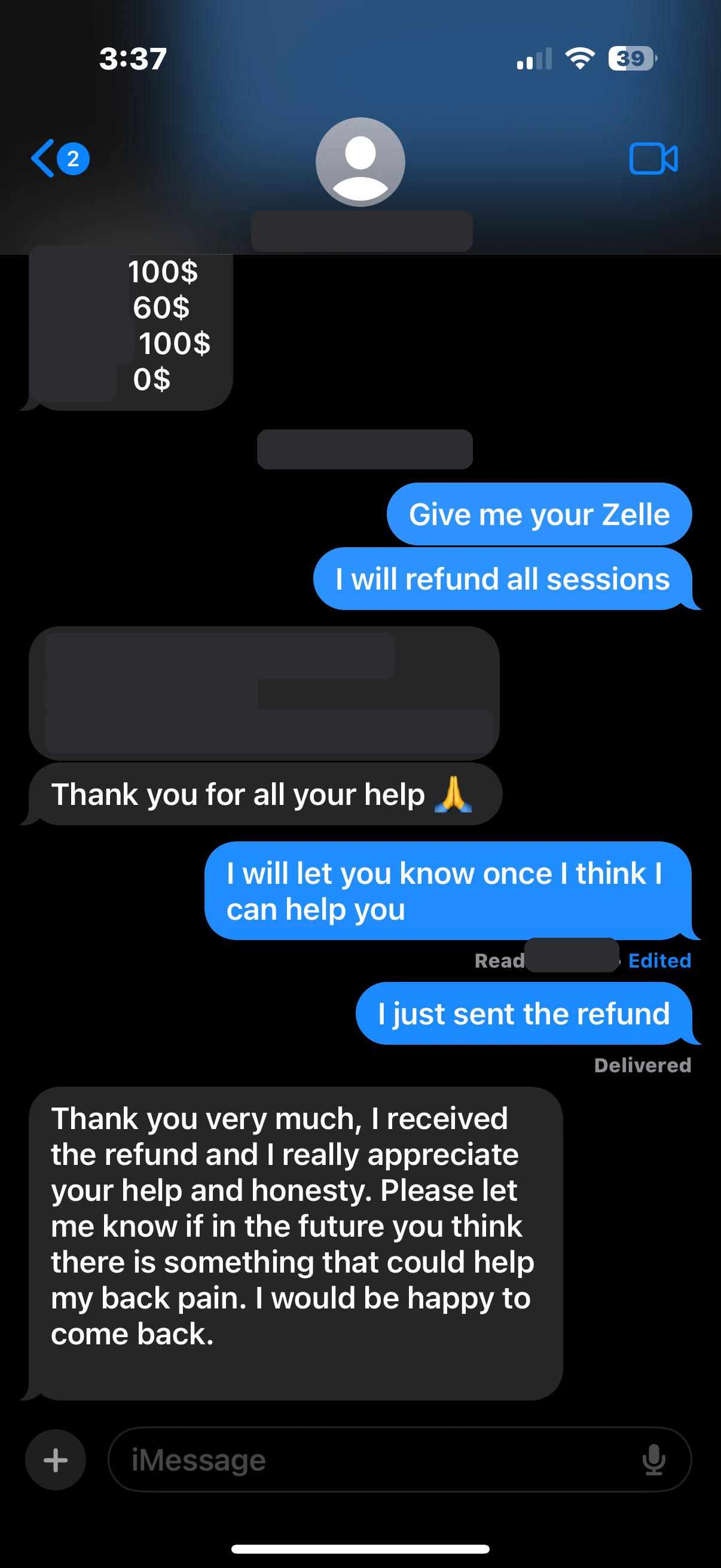
Real refund example “No Results. No Charge.” in Action A patient reported no noticeable improvement. The clinic refunded $360. View proof

Original screenshots. Identifying information and patient-related dates have been redacted.

01

The Request

The patient reported no noticeable improvement and asked whether the guarantee applied.

Redacted text message in which a patient reports no noticeable improvement and asks whether the guarantee applies Open full-size image
03

The Confirmation

The patient confirmed receiving the refund and thanked Dr. Yang for his honesty.

Redacted text exchange showing Dr. Yang offering a full refund and the patient confirming receipt Open full-size image

One Flat Fee.
No Pricing Games.

Standard appointment Initial visit: 55 minutes · Follow-up: 40 minutes $100
After-hours appointment Outside published clinic hours $140
Late cancellation or no-show Cancellation within 12 hours of the appointment start time $60

We do not bill insurance.
A superbill is available upon request for possible out-of-network reimbursement or for submitting to an HSA or FSA.

What Happens at Your First Visit?

Before your appointment

55 minutes
Initial visit
Eat beforehand
A normal meal or snack is enough.
Wear loose clothing
Sleeveless or short-sleeved tops and shorts are best.
Send imaging if available
MRI/X-ray images and reports are helpful, but not required.

Investigate before treating

He Predicts. Then You Feel the Proof.

Before recommending treatment, Dr. Yang:

  1. Starts with your symptom history.

    Dr. Yang asks how the problem began, what triggers it, and tests relevant movements.

  2. Maps beyond the painful spot.

    He examines the surrounding region and identifies tissue that does not glide normally.

  3. He Finds It Before You React.

    He tells you his prediction: which spots will feel tender and which will not. Only then does he apply the same moderate pressure to matching points on both sides, so you can feel the difference yourself. This sometimes reveals pain points you did not know existed.

From findings to a first step

See What He Found. Choose the Next Step Together.

Before treatment begins:

  1. See the overall pattern.

    Dr. Yang shows how the findings connect across your body, using visuals when helpful. He then guides you to feel the restricted tissue yourself.

  2. Connect the pattern to your symptoms.

    From those findings, Dr. Yang forms a working hypothesis: the mapped tissue tethers may be contributing to your symptoms.

  3. Choose how to begin.

    Dr. Yang recommends the tool that best fits the findings and explains why. Together, you decide whether and how to proceed, based on your tolerance and preferences.

Treat, retest & interpret

Begin With One. Adapt From There.

When acupuncture is the chosen tool:

  1. Try one needle first.

    Dr. Yang explains what to expect, then makes sure you feel okay before the next one. You can pause treatment at any time.

  2. Remap before continuing.

    After every needle, Dr. Yang checks what changed. The next needle targets what the updated map shows—not a preset sequence.

  3. Retest the original symptom.

    Once remapping shows enough change, we retest what triggers your symptoms whenever practical. The result becomes evidence: improvement supports the working hypothesis; an unexpected response leads Dr. Yang to reconsider it.

Aftercare & next steps

Leave With Aftercare You Can Replay.

Before you leave:

  1. Record your aftercare.

    Every patient records personalized instructions on their own phone to replay later. The recording covers what to expect, what to do and avoid, what to monitor, and when to contact the clinic.

  2. Understand today’s response.

    Dr. Yang reviews what was treated, how your tissue and symptoms responded, and what that means for the working hypothesis.

  3. Know what comes next.

    Dr. Yang recommends the next step based on what changed today. The full plan is refined according to how your symptoms respond to treatment and self-care.

Ready to Find Out What Was Missed?

Book an Appointment

Not sure your problem fits?

Text Dr. Yang at 949-233-9597 →

Typically replies within one business day.

Location

4000 Barranca Pkwy Suite 250, Room 16 Irvine, CA 92604

Clinic hours

Tuesday · Friday · Saturday 9:00 AM–12:30 PM 2:30–6:45 PM By appointment only.

Map showing Different Acupuncture at 4000 Barranca Parkway in Irvine
Open in Google Maps